

Recording Electric Guitar
Revisiting some techniques for capturing a range of electric-guitar sounds
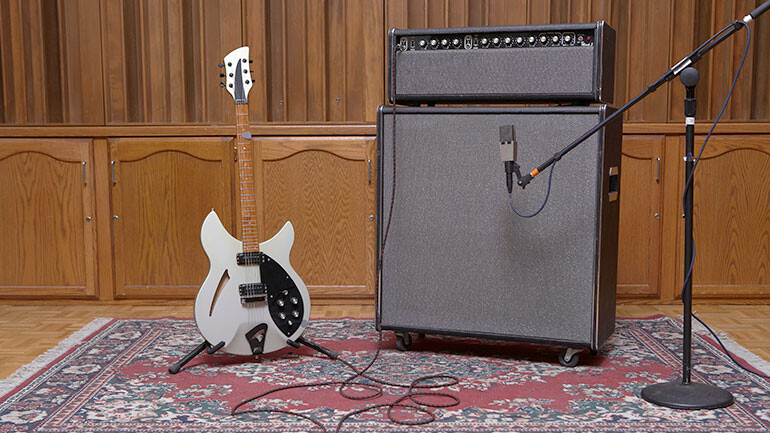
Like everything else, the key to successful electric-guitar recording is having a really good sound at the source—that is, dialing in the right amp tone, using an instrument that stays in tune and plays well, and of course having a player with a knack for solid guitar tracking. How you go about preserving those sounds is the other part of the equation, and here we revisit some oft-used techniques for capturing a range of electric-guitar progressions, fills and leads, using both single and multiple miking schemes, finding the right spot on the amp, recording the room and more.
The One-Mic Method
It doesn’t get any easier than just putting a single microphone on an amp, but for the best possible sound, spend a little extra time with positioning, distance, and perhaps experimenting with a few different mic types (if you’ve got them). Where you aim the mic can be a subjective decision, though often the native tone of the guitar and amp ultimately dictates the best spot. The basic rule of thumb is the closer you are to the middle of the speaker, the brighter the sound will be. Given that, you might record a guitar that has a darker or creamier tone by aiming more towards the center of the cone; by contrast, brighter guitars (such as those with single-coil pickups) may sound better when miking closer to the speaker’s edge (otherwise known as “off-axis” positioning).
While condensers, ribbons and other types of microphones have been used for amp recording over the years, the good news is that a relatively inexpensive dynamic mic often makes the best choice. A Shure SM57, for instance, can handle relatively high levels of volume and can be placed right up against an amp’s grille cloth when tracking. To “audition” the signal, strap on a set of good-fitting headphones, then gradually move the mic around the speaker until you hear a desirable sound. Nor is it necessary to crank the amp while recording—before you get started, raise the master just enough until you have a nice natural guitar tone in the room.
The Multi-Miking Method
There are times when an engineer might bring in a second microphone as a way to broaden the tonal possibilities. This typically involves using two different types of mics, such as a dynamic in combination with a large-diaphragm condenser; however, a pair of dynamics might do the trick as well. There are several ways of going about this; the first is to position the two mics equidistant from the amp—say, one pointed to the right of the speaker cone, the other on the speaker’s opposite side. There’s also the so-called “X-Y” method, in which the two mics are situated at a 45-degree angle so that their polar patterns cross each other (this approach is often used when a smoother sound is desired). Yet another strategy involves placing one mic close to the amp, and the other mic further back in order to achieve a less-direct, roomier sound. Take care, however, since phasing can occur whenever two mics on the same source aren’t equidistant; be ready to activate the reverse-polarity switch on either channel if the combined sound is tinny or otherwise unnatural.
Two Guitars in Stereo
Using multiple microphones allows you to split the signal so you can have the sound of a single guitar in stereo. But you might find it more interesting to add a second guitar that compliments the first. While you could conceivably play the exact same part twice, then position each on separate channels (at around 9 o’clock and 3 o’clock respectively), an even better approach would be to insert a part that has a unique rhythm and/or set of chord voicings than the original. As mentioned earlier, having a different type of guitar is the best way to create this contrast, however using the same instrument but slightly altering the amp tone, having one part cleaner than the other, or perhaps using a capo to change the chord voicing can also provide enough differentiation.




Community
Connect with BMI & Professional Songwriters