ES
EN

BMI & AI: What Music Creators Need to Know

BMI is an unwavering advocate on behalf of our creative community to ensure their voices are amplified in the fight for strong copyright protection and fair compensation in the age of AI.

BMI believes protecting human creativity is paramount, while also supporting the songwriters and composers who choose to use AI as a tool to enhance their creative process. That’s why BMI strongly champions a human-centered approach to AI that recognizes its potential, urges ethical use of copyrighted works, and demands respect for the unique value of songwriters, artists, creators, and performers.

Further, BMI believes that calls by some AI companies to pronounce AI training as “fair use” must be rejected. Protecting and valuing the work of music creators is essential, and AI companies should not be permitted to train on copyrighted works without obtaining permission and paying creators. It’s not “fair use,” it’s theft. 

Our Position
  • BMI protects and champions human creativity.
  • AI can be a useful tool to assist with songwriting and music production.
  • BMI supports and encourages registration of works that include AI-generated elements, as long as these works meet the U.S. Copyright Office’s standard of the minimum threshold for human creativity.
  • The use of copyrighted works by AI companies without permission to generate music that competes with human creators violates copyright law and undermines the rights and livelihoods of creators. It is not “fair use,” it’s theft.
  • BMI advocates for the right of all music creators to receive fair compensation for all uses of their works, alongside the freedom to create using the tools of their choice.

Affiliate and Industry Outreach

BMI is closely monitoring developments on the AI front. We’re working with our music industry partners to understand their positions on AI-generated content in musical works, and we have held numerous listening sessions with our affiliates to discuss the opportunities and challenges of AI. While some creators prefer to create without AI, we’ve heard from a number of songwriters and composers who have shifted their thinking and have started to embrace AI technology to support and enhance their creative process.

BMI Now Accepts Partially AI-Generated Works for Registration

Partial AI works will be compensated the same way as human created works without AI, provided the work meets the threshold for human creativity, as outlined by the U.S. Copyright Office. International royalties are processed in compliance with local regulations and society-specific policies.

Disclosure of AI Use

To ensure transparency and support accurate rights management, BMI will soon allow creators to disclose the use of AI tools when registering works that include partially AI-generated content in a way that impacts the composition. While not required, disclosure is recommended, as it helps maintain clarity around authorship and aligns with evolving industry standards. BMI will not be asking creators to report the use of AI tools that are part of production or support process and do not impact the authorship of the composition.

Below is more information on what is copyrightable and payable when registering your musical works with BMI.
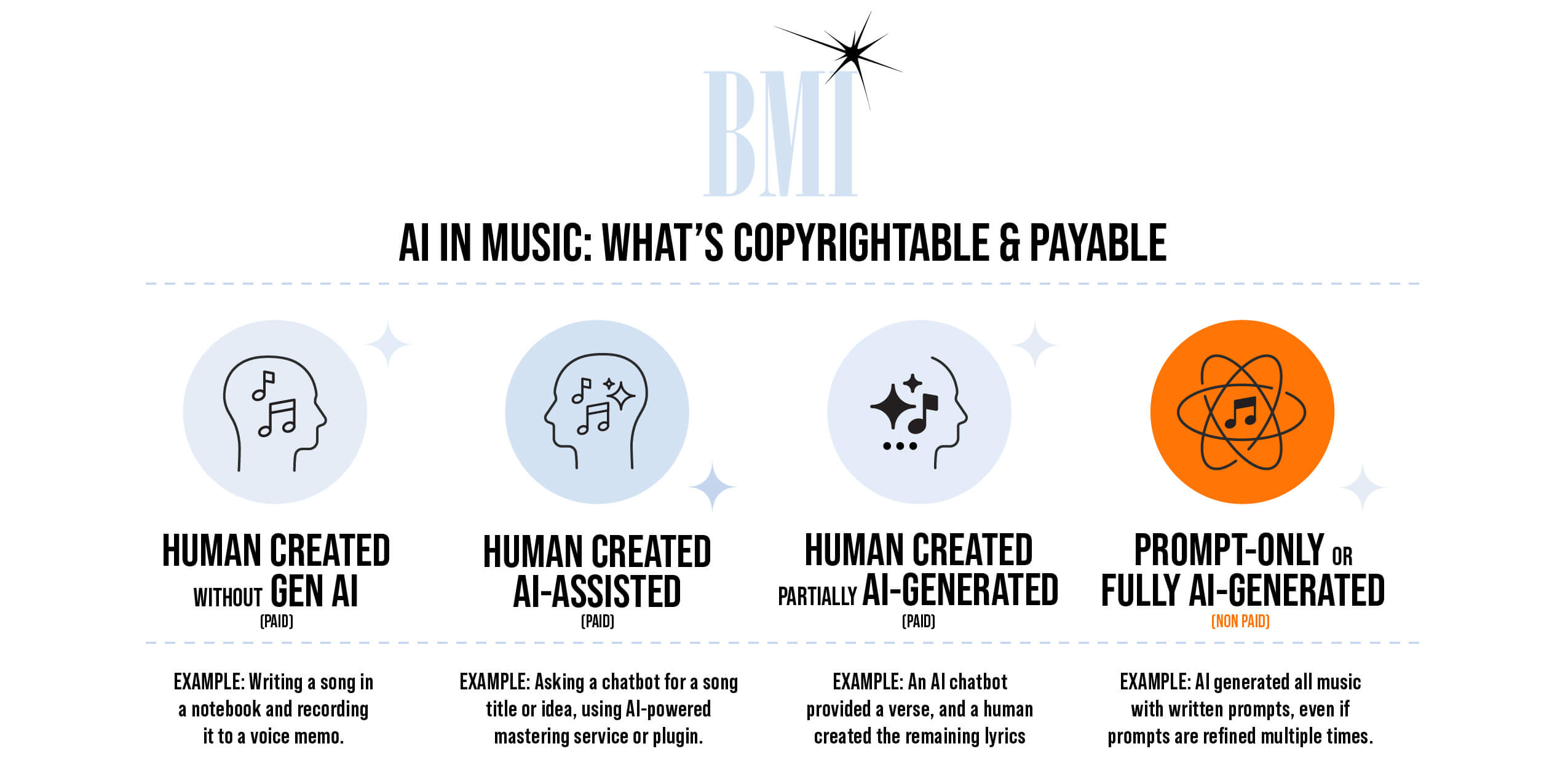
AI infographic
  1. Human Created Works Without AI

    These works are created entirely by humans without the use of AI tools.

    Examples Include:

    • Writing a song with pen and paper.
    • Using traditional tools like a rhyming dictionary or thesaurus.
    • Recording vocals or instruments using non-AI software or hardware.
  2. Human Created Works, Assisted by AI

    These works incorporate AI tools to support or enhance the human-led creative process.

    Examples Include:

    • Using ChatGPT or another AI tool to suggest a song title or rhyme.
    • Employing AI-powered plugins for mixing or mastering.
    • Using AI to remove background noise or enhance audio quality.
    • Generating chord progressions or melodic ideas with AI assistance, then building the song manually.
    • Using AI to transcribe a melody or convert a voice memo into sheet music.
  3. Human Created Works, with Partially AI-Generated Content

    These works include substantial AI-generated elements that are integrated into a human-led creative process.

    Examples Include:

    • Using ChatGPT to generate lyrics for the verse to complement the melody created by the songwriter.
    • Using an AI music platform to create a backing track, then adding original lyrics and vocals.
    • Using AI to generate a harmonic structure, then arranging and orchestrating the piece manually.
    • Using AI to generate multiple verses and selecting or editing portions to fit the creator’s overall concept.
  4. Prompt-Only AI-Generated Works

    BMI does not accept registrations for works that are generated entirely by AI using only text prompts, without meaningful human creative contribution. Even if multiple prompts are used to refine the output, the resulting work is considered fully AI-generated and is not currently eligible for copyright registration. This distinction ensures that BMI registrations reflect works with substantial human authorship, in alignment with current guidance from the U.S. Copyright Office.

    Examples Include:

    • Using platforms like Suno or Udio to enter text prompts and generate complete songs without adding original human-created lyrics, melodies, or instrumentation.
    • Generating a full composition by repeatedly refining prompts in an AI music tool, without contributing any human-authored musical or lyrical elements.
    • Creating a song entirely from AI-generated outputs, including lyrics, melody, harmony, and production, with no human editing or creative input beyond prompt selection.

BMI’s FAQs

BMI is always working to ensure that our affiliates are compensated for the public performances of their musical works. Given the rapidly evolving nature of AI, we will continue to build on BMI’s AI policy based on the latest legislation, litigation, and other music industry developments.

Please check back for continuing updates on BMI’s AI policy and FAQs below.


What determines if a work is fully or partially AI-generated?

  • Prompt-only or fully AI-generated musical works are works autonomously created by a computer algorithm running on a machine. This includes complete songs (including all music and lyrics) created with prompts only.
  • Partially AI-generated works include both human authorship and AI-generated content.

How are AI systems trained to create music?

Most AI companies are using models trained on human-created works. While some models are trained ethically through licensing or works for hire, many are trained by scraping copyrighted materials without permission. BMI believes in the ethical training of AI systems, meaning that all music creators should have choice whether their works are used in those systems, and they should be compensated if they are used. BMI encourages creators to use ethical AI, not platforms that are built on your works without consent, credit, or compensation. A resource to learn more is FairlyTrained.org.

Are prompt-only AI-generated musical works copyrightable?

No. Even if multiple prompts are used to refine the result, the resulting music is not currently considered eligible for copyright.

Are partially AI-generated musical works copyrightable?

Yes. The use of AI tools to assist rather than stand in for human creativity does not affect the availability of copyright protection for the output. The U.S. Copyright Office determines copyrightability of partial AI works on a case-by-case basis, evaluating the level of human creativity and contribution. For more information see the U.S. Copyright Office’s registration guidance at https://copyright.gov/ai/ai_policy_guidance.pdf.

Can I register prompt-only AI-generated works with BMI?

No. BMI does not accept registrations for prompt-only AI-generated works, as those types of works are not considered copyrightable under current U.S. law.

BMI reserves the right to remove a work from the BMI repertoire if it is determined to be a prompt-only AI work or is otherwise improperly registered.

What do I do if I’ve already registered a prompt-only AI-generated work with BMI?

Please email reviseworks@bmi.com and a BMI representative will assist you in removing the work.

Can I register partially AI-generated works with BMI?

Yes, BMI supports the use of AI tools to enhance human creativity. A partially AI-generated work may be registered as long as it meets the U.S. Copyright Office’s standard of the minimum threshold for human creativity.

Please see the U.S. Copyright Office Registration Guidance for more information on partially AI-generated works (https://www.copyright.gov/ai/).

Are partially AI-generated works paid by BMI?

Yes, partial AI works are not compensated differently, provided the work meets the threshold for human creativity. International royalties are processed in compliance with local regulations and society-specific policies.

Are there any guidelines for how much human creativity is needed vs. AI for a work to be registered with BMI?

We follow the well-established existing U.S. Copyright Office’s standard for human authorship. As long as the composition isn’t solely created with AI prompts and there is a blend of AI and human creativity, whether it’s the melody, lyrics or music, it can be registered with BMI and is considered fully payable.

Can an AI company be considered an author of an AI-generated work?

No. Based on guidance from the Copyright Office, only humans can be considered authors or writers of a work. Therefore, affiliates cannot currently register an AI company or the owner or creator of the AI tool as a writer. Similarly, an AI company would not be able to register as a publisher of a work unless a human creator assigns their publishing rights to the AI company.

BMI reserves the right to remove a work from the BMI repertoire if it is determined to be an AI work or is otherwise improperly registered.

If my prompt-only AI-generated work is performed internationally where AI works are given copyright protection, will BMI pay me for performance of the work?

BMI will continue to follow Copyright Office guidance on U.S. law. However, BMI is actively engaging in discussions with foreign PROs and closely monitoring developments in the industry as well as the applicable laws in each country.

Does training AI models on copyrighted music without permission qualify as fair use?

No. When AI platforms use copyrighted works without authorization to generate music that competes with human creators, this undermines the principles of copyright law and should not be considered “fair use.” Such practices threaten the sustainability of creative industries and the rights of original songwriters, composers, and artists. BMI encourages creators to use ethical AI, not platforms that are built on your works without consent, credit, or compensation. Please see the U.S. Copyright Office Fair Use Index for more information on fair use (https://www.copyright.gov/fair-use/index.html)

Resources Icon

RESOURCES

We’ll continue to add educational resources, upcoming events and tools to help you navigate the ever-changing world of AI, so please check back.


LEARN MORE

Get the latest updates from the U.S. Copyright Office at https://www.copyright.gov/ai/.

To learn more about the Copyright Office’s initiative to examine copyright law and policy issues raised by AI technology, watch Webinar: Registration Guidance for Works Containing AI-generated Content | U.S. Copyright Office

Some companies are developing generative AI music models that only use copyrighted works with permission, which is known as “ethical AI.” To learn more about ethical AI, and the companies that are taking a more consent-based approach to training, visit Fairly Trained.

GET INVOLVED

Learn more about the Human Artistry Campaign at https://www.humanartistrycampaign.com/. Consider signing the petition in support of fundamental AI principles for the responsible use of artificial intelligence.

You can sign the “Statement on AI Training,” which rejects the unlicensed training of generative AI models on creative works.

Check Back for Continuing Updates