

Recording Horns at Home
Best practices for tracking trumpet, saxes, flutes and the like
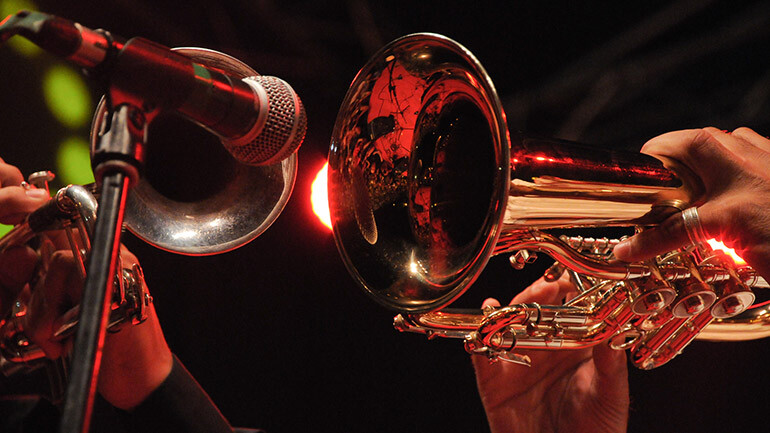
For anyone whose repertoire is mainly limited to guitars or keyboards, bringing in a horn soloist or section can be an exciting diversion, provided you have a basic understanding of how to capture these lush but voluminous instruments. Here are some ideas for working with both brass and woodwinds, including which microphones are preferable, placement variations, recording a solo instrument versus a group of players, and other thoughts.
Brass tracks. Let’s start with horn instruments that produce their sound through bells—trombone, trumpet, flugelhorn, French horn, to name a few. These are highly directional instruments, and as such require a specific approach to miking and positioning in order to capture the full range of the instrument’s tonality. And like all horns, trumpets, trombones, and the like produce a ton of sound—yet another factor when setting up the recording channel. A larger diaphragm dynamic microphone such as the Electro Voice RE-20 or Sennheiser MD421 generally works best when recording lower-register instruments like trombone or French horn; for trumpet, even a plain vanilla Shure SM58 will be adequate. Place the mic roughly 1-2 feet from the center of the bell to capture enough direct sound; particularly when recording trumpet or trombone you’ll want to use a volume pad to reduce the amount of microphone gain (by either -10db or -20db, depending on the positioning of the instrument and strength of the player).
Working with woodwinds. A slightly different approach is called for when recording saxes, as well as flute, clarinet, and other woodwinds where the sound comes “across” the instrument. With an alto, tenor, or baritone saxophone the idea is to capture both the sound emerging from the bell as well as the lusher tones coming from the upper portion of the instrument. Because they’re not nearly as dynamic as the front end of a trumpet, saxophones generally sound best when using a large-diaphragm condenser microphone such as an AKG C-414 or RODE NT-2, pointed slightly off-axis or between the bell and the player’s fingers. Having said that, many engineers still prefer miking the sax directly above the bell, which results in a more aggressive sound (as heard on the Beatles’ “Lady Madonna,” for instance). The outlier is a straight soprano saxophone, which, due to its higher frequency, usually works when using a dynamic microphone, as you would when recording trumpet or trombone. Because the tone can turn abrasive when recording straight on, it’s best to aim the mic off-axis or towards the middle part of the instrument.
Recording flute requires yet another miking and placement variation. Unlike the previous examples, most of the sound comes from the top part of the instrument, including the staccato breathiness we commonly associate with pop and rock flute playing. Hence the challenge is getting close enough to capturing the full tonality of the instrument while also avoiding the plosive sounds emanating from the player’s mouthpiece. The best solution is miking from above—say, about a foot or so from the center of the instrument, angled slightly towards the front end, using a large-diaphragm condenser mic (outfitted with a wind screen to prevent breath pops from intruding).
Recording a horn section. The above miking strategies change, however, when recording horns as an ensemble of four or five players. If possible you’ll want to arrange the instruments in a semi-circle, then suspend a pair of overhead mics (matched condensers if you’ve got them, or even inexpensive Shure SM57s if you don’t) in front of the players elevated to a height of 5-6 feet, placed on either side of the group and pointed toward the center (and making sure to keep enough distance between the mics to avoid phase cancellation).
There are certain instruments that just sound much better in a larger, ambient room, and horns are no exception. Of course, when recording at home where space is a premium, it’s necessary to add ambience after the fact. When tracking a horn section or soloists, a dollop of reverb can go a long way; just remember to keep a bit of pre-delay before the echo effect to prevent the natural sound of the instruments from getting lost. Also, listen carefully to the room during the performance, making sure there aren’t any flutter echoes or other sonic disturbances getting in the way, and perhaps adding some basic sound treatment (such as throw rugs or upholstered furniture) if necessary.




Community
Connect with BMI & Professional Songwriters