

Building a Better Backbeat
Some simple as well as more sophisticated recording techniques for getting the most out of your drum kit
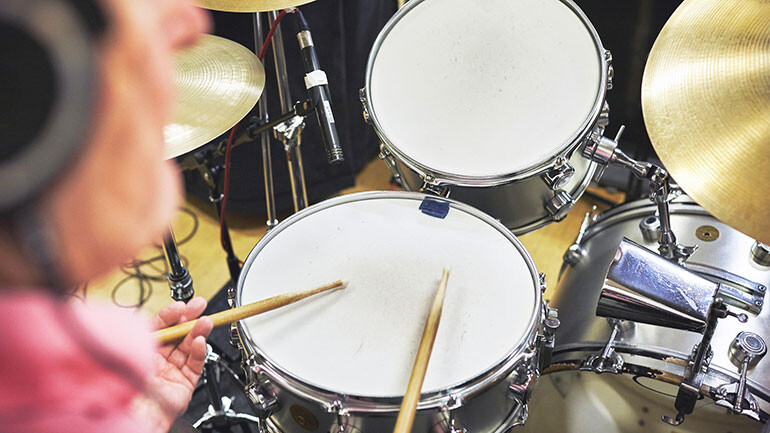
Recording drums ranks among the most challenging of home-recording activities, which is why we periodically revisit the subject with new ideas and fresh approaches. Here we present another cross-section of percussion miking strategies, from ultra-basic to more sophisticated techniques requiring multiple mics strategically placed around the kit. Before you get going, remember that a good recorded drum sound starts with a good-sounding drum set—to wit, make sure all drumheads are in decent shape and are properly tuned, using dampening material and hardware adjustments to eliminate excessive ringing, snare rattling, pedal squeaks or other unwanted noises. A sympathetic space, such as one with a bit of wood paneling and some carpeting out front providing the right blend of reflection and absorption, doesn’t hurt either. And let’s not forget the most important part: a solid drummer who plays with great feel and sounds superb in the room. Once you have that, just put up some mics and off you go. Here’s how.
Start with One
The easiest way to get a no-frills drum recording is to keep it simple—and to that end it’s hard to top the one-mic method. Here, you place a single mic about 4-6 feet from the front of the kit, aimed slightly above the bass drum and pointed towards the snare drum. Anything from a condenser mic to a simple dynamic such as a Shure SM58 will do, though the latter may actually work better as it has a lower high-frequency range and therefore keeps cymbal crashes from dominating the sound. The benefit is that the whole kit is confined to a single track, with none of the phasing issues that can occur when multi-miking (more on that in a bit); the downside is you’re limited to a plain mono image unless you’re recording the drums in a live situation.
The Two-Mic Approach
Bringing in a second microphone offers a little more flexibility than the ultra-basic method above. In addition to the front-facing mic, you could situate a second dynamic mic directly over the snare drum; this so-called “spot mic” adds focus to the backbeat while still maintaining an overall ambient feel. An alternative would be to place a pair of mics directly over the kit with each mic pointed away from the other at a 45-degree angle. Keeping the mics close together wards off phase cancellation, which happens when two mics aren’t positioned at an equal distance to the center of the kit; the drawback is that the bass drum may not be as present without a dedicated mic in use. Which brings us to…
The Three-Mic Method
Using this “Glyn Johns formula” (so named for the great British recording engineer of the ‘60s-‘70s) we’re now getting closer to a professional vibe while still maintaining a relatively simplistic setup. To achieve a more focused bass-drum sound, we’ll place a low-frequency mic (such as the AKG D112, or even a Shure SM58) directly in front of the drum’s outer resonant head; or, with the head removed, inserting the mic directly inside the drum and pointed straight at the beater (for a “clickier” kick sound). A mono overhead mic (preferably a large-diaphragm condenser) goes directly above the center of the kit aimed toward the snare drum; a third mic is then placed over the floor tom and elevated a few feet so that it acts a bit like an overhead as well. A fourth mic may also be used on the snare drum if a bit more “crack” is required.
Four or More
Of course, in many pro situations it’s not uncommon to find upwards of 8-10 mics or more slung over a single drum kit. If you’re really feeling adventurous, you could try using two overheads (preferably a matched pair), a bass drum mic, one spot mic each for the snare, rack toms and floor tom-tom, an additional mic placed underneath the snare drum (to get a bit of snare rattle), and, for a wider, more dynamic sound, a set of slightly elevated room mics placed a good 6-10 feet in front of the drum kit.
Watch Out for Phasing!
The downside of hanging a lot of mics in close proximity is that you run the risk of phasing, which occurs when two mics pointed at the same instrument are out of phase with one another, resulting in a thinner, inferior sound. There are a number of ways to prevent this—first, make sure that overheads are situated equidistant from the snare drum, and are placed three times higher than any other mic directed at the same source (a.k.a. the “3-in-1 rule”); if using more than one mic on any drum for that matter, both should be directed at the same spot, again placed at the same distance to the drumhead (to prevent sound from being delayed to either mic). You can also flip the phase-inversion switch on your console (if available) to reverse the polarity of any paired microphone, then simply use your ears until you hear the “right” sound.




Community
Connect with BMI & Professional Songwriters